
Wednesday, June 06, 2012


Weirdly Specific Signage
I've been passing this sign for six months, and I finally just had to post it. I find it so odd... not only is it weirdly specific (you couldn't just round up to half a mile?), but they also didn't reduce their fraction to 2/5 of a mile.
So strange.
And specific.

So strange.
And specific.

Thursday, May 24, 2012
Showing Great Respect
Mesa Prep is a charter school near Phoenix, AZ. Their baseball team is really good, and incidentally their starting 2nd baseman is a 2nd basewoman. Twice this year they played Our Lady of Sorrows, a school of kind-of Catholics for whom the actual Catholics are just far too liberal. Both times OLoS refused to play Mesa Prep if they fielded their starting 2nd baseman. They apparently have a rule prohibiting co-ed sports. So Mesa prep didn't play their best player at 2nd and won both games.
In their league championship Mesa Prep decided that they wouldn't sit her, and OLoS forfeited.
Here's a fun couple of paragraphs from the Washington Post article about the game:
So these boys are learning to respect Paige Sultzbach by refusing to play a game where they will never be forced to touch her.
Mesa Prep remains undefeated, and in every single measure of success, Our Lady of Sorrows just couldn't be more defeated.
In their league championship Mesa Prep decided that they wouldn't sit her, and OLoS forfeited.
Here's a fun couple of paragraphs from the Washington Post article about the game:
The [OLoS] statement also said the school teaches boys respect by not placing girls in athletic competition, where “proper boundaries can only be respected with difficulty.”
Our Lady of Sorrows is run by the U.S. branch of the Society of Saint Pius X. The group represents conservative, traditional priests who broke from the Catholic Church in the 1980s.
So these boys are learning to respect Paige Sultzbach by refusing to play a game where they will never be forced to touch her.
Mesa Prep remains undefeated, and in every single measure of success, Our Lady of Sorrows just couldn't be more defeated.
Thursday, May 10, 2012
Purity
From the food52 blog:
How can salt (NaCl) be both "rich in minerals" and "one of the purest salts" at the same time? "Pure" means not having stuff in your substance that isn't the substance itself. If you are talking about salt,than then minerals other than salt in your salt makes that salt impure.
Impurities might be good, but they are what they are.
I've been hearing about Himalayan salt now for several years, and it's always hyped as a miracle medicine that can cure you of essentially any ailment, and it can do it in a variety of ways. When some substance that is purported to actually exist somewhere is said to be able to cure you of anything, then it is helpful to ask about the health of the people living near the miracle substance. Nepalis who mine this salt do not, despite all the claims for this miracle drug, live forever.
And, by the way, most Himalayan Salt is mined in Pakistan hundreds of miles from the Himalayas.
God Bless Marketing.
Himalayan Salt: Hand-mined from ancient sea salt deposits from the Khewra Salt Mine in Pakistan, Himalayan salt is rich in minerals and believed to be one of the purest salts available
How can salt (NaCl) be both "rich in minerals" and "one of the purest salts" at the same time? "Pure" means not having stuff in your substance that isn't the substance itself. If you are talking about salt,
Impurities might be good, but they are what they are.
I've been hearing about Himalayan salt now for several years, and it's always hyped as a miracle medicine that can cure you of essentially any ailment, and it can do it in a variety of ways. When some substance that is purported to actually exist somewhere is said to be able to cure you of anything, then it is helpful to ask about the health of the people living near the miracle substance. Nepalis who mine this salt do not, despite all the claims for this miracle drug, live forever.
And, by the way, most Himalayan Salt is mined in Pakistan hundreds of miles from the Himalayas.
God Bless Marketing.
Monday, March 12, 2012
Release the Piecooken!
This is very likely to be the longest post of my blogging career. But sometimes things just work out that way.
Not terribly long ago, Fred Clark, The Slacktivist, posted on his blog about an amazing creation. It came from pinterest, or facebook, or somewhere. Wherever it came from, it became a kind of fascination for me, and was a topic of conversation between me and my friends. It was the Piecaken. An unholy child of pie and cake, and cousin to the turducken. The Piecaken is a pie baked into a cake. And it is amazing! I finally decided that I had to make a piecaken.
My fascination grew into an obsession, and then my obsession grew into... well it grew. And from that mighty something-greater-than-an-obsession came the idea of making something greater than a piecaken. What could possibly up the ante on a pie baked into a cake? Well cookies, baked inside of a pie, which is baked inside of a cake! After some thinking, and some considering, I decided that I would make a double-layer cake, with a pie baked into a cake on one layer, and cookies baked into a cake for the second layer. I would call my creation: The Piecooken!
This weekend I brought this creation to life. This is my story:
First, I started with a the pie:


This is my basic, trusty pie dough recipe, easy to make, and serviceable for any pie. This recipe was taught to me by a wonderful friend of mine from south/central Illinois. Her pies are indescribably delicious. I spent a great weekend with her almost 15 years ago learning the craft.
It didn't matter much to have uniform-sized cookies:

Here is the vanilla cake batter, the custard pie, the vanilla wafer cookies and the springform pan. I really felt that the springform pan was critical to extracting the layers. I only have one, so it was a two-stage baking process. Well... four-stage if you count the two batches of cookies.

I poured half the batter, layered some cookies, then poured the rest of the batter over the cookies.
 And after 45 minutes and a mini-collapse by McIlroy, the first layer was out:

I needed a strategy for the second layer. I was worried about the pie layer being harder to bake than the cookie layer. I was also dangerously under-caffeinated, so I made a cup of coffee.

I sipped coffee while figuring out the pie-layer cake type. Caffeine helped me decide on a strawberry cake for the pie layer.

Here I made a critical decision with the pie. I decided against a top crust. Looking back, this was a real mistake, but Tiger went out with a knee injury, which seemed to point out that I was running out of day. No top layer. Into the springform pan when a layer of strawberry cake and the pie on top of it:

The first problem with the topless custard pie came 40 minutes later when I went to check for doneness. When inserted into a pile of custard through a layer of cake, a toothpick always comes out wet!!
I had to just bake the crud out of that layer and hope for the best.

You can see the slight crater in the center. I theorized that the wetness of the custard never allowed the proper crumb to form in the cake layer above it. But it was reasonably solid after a cooling off period. I was encouraged that the pie layer did not ooze out when I removed it from the pan.
Here are the companion layers side-by-side. You can see the pie layer is substantially taller than the cookie layer.

Next came the frosting. My wife found a marvelous buttercream frosting recipe a few weeks ago, and so I tried my hand at it. It went well. In the picture, if you look behind the mixer to the left, you can see the brain-mold I use to make a pretty plausibly-colored brain jello every halloween.

The frosting begins. I decided to take advantage of the divot in the pie layer, so I inverted the slightly convex cookie layer over the slightly concave pie layer and it was a perfect match.


After the best bit of piping and scraping, I had the best-frosted cake I have ever made:

And now... the moment of truth.

The strawberry layer had indeed suffered from a poorly-set area above the custard pie, so it was not perfect. But it was perfectly fine.
The taste was pretty good...
For next time, and there will be a next time, I will plan ahead, I will turn off the golf, and I will make a true piecooken--cookies baked inside a pie which is then baked inside a cake. But for now, I bid you good night.

I would rather have banished myself forever from my native country and wandered a friendless outcast over the earth than have consented to this miserable marriage. -- Victor Frankenstein, "The Modern Prometheus"
Not terribly long ago, Fred Clark, The Slacktivist, posted on his blog about an amazing creation. It came from pinterest, or facebook, or somewhere. Wherever it came from, it became a kind of fascination for me, and was a topic of conversation between me and my friends. It was the Piecaken. An unholy child of pie and cake, and cousin to the turducken. The Piecaken is a pie baked into a cake. And it is amazing! I finally decided that I had to make a piecaken.
My fascination grew into an obsession, and then my obsession grew into... well it grew. And from that mighty something-greater-than-an-obsession came the idea of making something greater than a piecaken. What could possibly up the ante on a pie baked into a cake? Well cookies, baked inside of a pie, which is baked inside of a cake! After some thinking, and some considering, I decided that I would make a double-layer cake, with a pie baked into a cake on one layer, and cookies baked into a cake for the second layer. I would call my creation: The Piecooken!
This weekend I brought this creation to life. This is my story:
First, I started with a the pie:


This is my basic, trusty pie dough recipe, easy to make, and serviceable for any pie. This recipe was taught to me by a wonderful friend of mine from south/central Illinois. Her pies are indescribably delicious. I spent a great weekend with her almost 15 years ago learning the craft.
I had a day to myself, with family gone, so this was a project almost entirely driven by whim. There was also a golf tournament on TV so I didn't want to go to the store, so I had to make do with ingredients I already had in the house. I thought about a top-crusted fruit pie, but instead I made a custard:

This was a basic custard from the classic Better Homes and Gardens (1993 edition, in my case) cookbook.
It's a wonderful custard. I decided to do a chocolate custard, but at the moment in the recipe that calls for adding the cocoa Rory McIlroy sank an eagle putt to pull to within 2 shots of the lead and I lost my head. So with a fully-thickened vanilla custard, I had my pie.

One reason to go with a chocolate custard was that my cookies were going to be vanilla wafer cookies. But with my custard gaff already in the bag, I marched forward with vanilla wafer cookies anyway. Creaming the sugar and butter is always the happiest moment in a cookie baking day.

It didn't matter much to have uniform-sized cookies:

Here is the vanilla cake batter, the custard pie, the vanilla wafer cookies and the springform pan. I really felt that the springform pan was critical to extracting the layers. I only have one, so it was a two-stage baking process. Well... four-stage if you count the two batches of cookies.

I poured half the batter, layered some cookies, then poured the rest of the batter over the cookies.
 And after 45 minutes and a mini-collapse by McIlroy, the first layer was out:
I needed a strategy for the second layer. I was worried about the pie layer being harder to bake than the cookie layer. I was also dangerously under-caffeinated, so I made a cup of coffee.

I sipped coffee while figuring out the pie-layer cake type. Caffeine helped me decide on a strawberry cake for the pie layer.

Here I made a critical decision with the pie. I decided against a top crust. Looking back, this was a real mistake, but Tiger went out with a knee injury, which seemed to point out that I was running out of day. No top layer. Into the springform pan when a layer of strawberry cake and the pie on top of it:

The first problem with the topless custard pie came 40 minutes later when I went to check for doneness. When inserted into a pile of custard through a layer of cake, a toothpick always comes out wet!!
I had to just bake the crud out of that layer and hope for the best.

You can see the slight crater in the center. I theorized that the wetness of the custard never allowed the proper crumb to form in the cake layer above it. But it was reasonably solid after a cooling off period. I was encouraged that the pie layer did not ooze out when I removed it from the pan.
Here are the companion layers side-by-side. You can see the pie layer is substantially taller than the cookie layer.

Next came the frosting. My wife found a marvelous buttercream frosting recipe a few weeks ago, and so I tried my hand at it. It went well. In the picture, if you look behind the mixer to the left, you can see the brain-mold I use to make a pretty plausibly-colored brain jello every halloween.

The frosting begins. I decided to take advantage of the divot in the pie layer, so I inverted the slightly convex cookie layer over the slightly concave pie layer and it was a perfect match.


After the best bit of piping and scraping, I had the best-frosted cake I have ever made:

And now... the moment of truth.
You seek for knowledge and wisdom, as I once did; and I ardently hope that the gratification of your wishes may not be a serpent to sting you, as mine has been. — Victor Frankenstein, "The Modern Prometheus"

The strawberry layer had indeed suffered from a poorly-set area above the custard pie, so it was not perfect. But it was perfectly fine.
The taste was pretty good...
For next time, and there will be a next time, I will plan ahead, I will turn off the golf, and I will make a true piecooken--cookies baked inside a pie which is then baked inside a cake. But for now, I bid you good night.

Sunday, March 04, 2012
20 Years Ago
I cleaned out a closet this weekend and came across an old piece of art from my friend Jim. I laughed as hard about it today as I did 20 years ago:


Friday, December 30, 2011
Uncrossable Barriers
I do not get dance.
I don't hate every dance I see, and I've successfully not hated some dance performances, but I am dumfounded that it exists in such abundance and in so many forms.
I love music, and over the years I've been introduced to music I didn't like, or didn't get, but mostly with the venerable forms I come to appreciate or even love it. I definitely didn't get opera when I was a kid, but over the years and with my mother's influence, I have seen the light. I have a favorite opera singer, even. One of the great birthday presents of recent years was when my wife got me tickets to my favorite opera singer at Ravinia.
I've gone through such transformations with various forms of classical, jazz in a few forms, cubist paintings, and many others.
But not dance. I have seen the Bolshoi ballet, the Bolshoi academy, and the Hubbard Street Dance group. I have tried, and I can appreciate the athleticism for sure, and occasionally there's a bit of a dance, or an individual performance that is just amazing, but unless it's essentially tap dancing from the 1940s or '50s, I just get so bored so fast.
I kind of want to love dance as much as I love most other art... I just don't seem to be able to.
I don't hate every dance I see, and I've successfully not hated some dance performances, but I am dumfounded that it exists in such abundance and in so many forms.
I love music, and over the years I've been introduced to music I didn't like, or didn't get, but mostly with the venerable forms I come to appreciate or even love it. I definitely didn't get opera when I was a kid, but over the years and with my mother's influence, I have seen the light. I have a favorite opera singer, even. One of the great birthday presents of recent years was when my wife got me tickets to my favorite opera singer at Ravinia.
I've gone through such transformations with various forms of classical, jazz in a few forms, cubist paintings, and many others.
But not dance. I have seen the Bolshoi ballet, the Bolshoi academy, and the Hubbard Street Dance group. I have tried, and I can appreciate the athleticism for sure, and occasionally there's a bit of a dance, or an individual performance that is just amazing, but unless it's essentially tap dancing from the 1940s or '50s, I just get so bored so fast.
I kind of want to love dance as much as I love most other art... I just don't seem to be able to.
Wednesday, March 30, 2011
Dear Gen, Bolden
I wrote the following to General Bolden, NASA's current administrator:
3/28/2011
General Charles F. Bolden, Jr.
Administrator
NASA
300 E Street SW
Washington D.C., 20546-0001
Gen. Bolden,
My family and I are members of the Adler Planetarium in Chicago, IL. As I’m sure you know, the museum is one of the great institutions in the city of Chicago, and also holds a special place as one of the United States’ great museums dedicated to space exploration.
My family would love to see one of the shuttle orbiters retired to the care of the Adler. It’s hard to imagine a more appropriate place in the country. Adler houses the oldest piece of space exploration equipment outside of Europe—an Italian telescope from the early 1600s. I imagine taking my daughter, an 11 year-old space enthusiast, to visit this telescope at the same time she can see the most important tool for 20th century space exploration, and I quite literally get chills.
Please consider the Adler’s bid to house a retired shuttle, you won’t find a more fitting or caring institution.
Regards,
Matt Dick
---
The unstated PS to this letter:
Seeing a shuttle on the shore of Lake Michigan would be so cool!
Thursday, March 24, 2011
Baldness

A few years ago I was planning for a St. Baldrick's even and told the group I was working in at the time, "In a few weeks, I'm going to go bald."
My very bald manager paused, then said, "Matt, I don't think you understand how this works."
A few weeks ago I went bald, as most of you know. Here's my beautiful scalp in all its glory.
When all donations are in, I will have raised over $4,000 and you all have helped raise more than $30,000 in my time with St. Baldricks.
But the big number is what our team, Nathan's Network has raised. This year we topped $25,000, which is spectacular!
Since 2005 we have raised $127,724 largely thanks to you who are reading this.
I can't thank you enough.
Tuesday, March 15, 2011
NPR and Public Insanity
I have this issue. I don't care for NPR (National Public Radio). My issues with it are on a number of fronts, and here's a partial list:
1) It's boring. I know people just love "car talk". I have never heard it, but almost nothing interests me less than talking about cars. There are things I'm sure I'd like, but there are whole sections of it that just can't possibly be worth anyone's time.
2) It's sooooooooo Liberal Correct. It obviously makes people feel good to say they listen to NPR. Maybe it does and maybe it is good to listen to NPR, but it definitely makes people feel good to say it. That bugs me.
3) It's partially federally funded and it's obviously liberal in it's bent. Not the worst offense, but hardly objective.
4) My libertarian feelings are bothered by funding a radio station. I just think the government needs to fund things that aren't public luxuries.
Okay. So that all having been said, I'm hearing lots of conversation about defunding NPR because of, and I (almost) quote a real, honest to goodness smart guy Howie Kurtz, "I don't know that we need to fund this during this time of real economic hardship."
Maybe I got the words wrong, but this was his message, and the message of at least two or three other pundits I've heard on the subject.
Really?!
Here is what the federal budget spent in 2010:
$3,552,000,000,000
Here is what NPR cost the federal government in 2010:
$25,440,000
Not kidding, that's the actual number.
If you subtract the entire NPR budget from the US spending, US spending will be relieved of 0.0007% of its budget.
Whew! Let's get right on that!
Seriously, is NPR even worth the conversation? The federal deficit last year was 49% of revenue.
49%
Killing NPR would make that number:
48.9993%
I am not advocating that we waste $25 million, I do have libertarian leanings. But I'm also a realist. Do we really need to waste time talking about 0.0007% of the federal budget in this time of real economic hardship?

1) It's boring. I know people just love "car talk". I have never heard it, but almost nothing interests me less than talking about cars. There are things I'm sure I'd like, but there are whole sections of it that just can't possibly be worth anyone's time.
2) It's sooooooooo Liberal Correct. It obviously makes people feel good to say they listen to NPR. Maybe it does and maybe it is good to listen to NPR, but it definitely makes people feel good to say it. That bugs me.
3) It's partially federally funded and it's obviously liberal in it's bent. Not the worst offense, but hardly objective.
4) My libertarian feelings are bothered by funding a radio station. I just think the government needs to fund things that aren't public luxuries.
Okay. So that all having been said, I'm hearing lots of conversation about defunding NPR because of, and I (almost) quote a real, honest to goodness smart guy Howie Kurtz, "I don't know that we need to fund this during this time of real economic hardship."
Maybe I got the words wrong, but this was his message, and the message of at least two or three other pundits I've heard on the subject.
Really?!
Here is what the federal budget spent in 2010:
$3,552,000,000,000
Here is what NPR cost the federal government in 2010:
$25,440,000
Not kidding, that's the actual number.
If you subtract the entire NPR budget from the US spending, US spending will be relieved of 0.0007% of its budget.
Whew! Let's get right on that!
Seriously, is NPR even worth the conversation? The federal deficit last year was 49% of revenue.
49%
Killing NPR would make that number:
48.9993%
I am not advocating that we waste $25 million, I do have libertarian leanings. But I'm also a realist. Do we really need to waste time talking about 0.0007% of the federal budget in this time of real economic hardship?
Wednesday, February 16, 2011
And the circle is closed...
As of last night, humans are unnecessary in my house.
Margot found a song clip on her phone to use as a ringtone. She liked it enough that she wanted to get the full song to put on her iPod. Typing the lyrics into google didn't seem to be doing any good, so I used an app on my Droid (Shazam), to listen to the clip and identify it.
It didn't work... Shazam didn't correctly identify that clip, but as Margot and I stood over our phones, I was struck by the fabulous realization that my phone was listening to her phone and Margot and I were something less than strictly necessary.

Margot found a song clip on her phone to use as a ringtone. She liked it enough that she wanted to get the full song to put on her iPod. Typing the lyrics into google didn't seem to be doing any good, so I used an app on my Droid (Shazam), to listen to the clip and identify it.
It didn't work... Shazam didn't correctly identify that clip, but as Margot and I stood over our phones, I was struck by the fabulous realization that my phone was listening to her phone and Margot and I were something less than strictly necessary.
Disgusting
So we have people in Mississippi who want to put Nathan Bedford Forrest on a license plate that people can buy.
In this CNN video clip we have a Greg Stewart arguing that Forrest was a brilliant Confederate general and so deserves this honor on some level.
There is so much to say about this kind of thing, but I'll confine myself to just a few points. In this clip the men debated whether or not Forrest was the first grand wizard of the KKK. Of course if he was, even Stewart would have to back off the endorsement of the license plate. What wasn't in dispute is that Forest was a slave trader and owner. This, apparently, is not a deal-breaker for the reprehensible Mr. Stewart.
But what wasn't really touched on was why Gen. Forrest should be honored at all. If he was an undisputed slave trader, what is the actual point behind honoring him? I agree that not every confederate soldier should be condemned for his part in that revolt, but why go out of our way to honor them? What good did any of them perform? It is an obvious attempt at glorifying a racially divisive figure. And that glorification is horrid and disgusting at worst, and stupid and ignorant at best.
In this CNN video clip we have a Greg Stewart arguing that Forrest was a brilliant Confederate general and so deserves this honor on some level.
There is so much to say about this kind of thing, but I'll confine myself to just a few points. In this clip the men debated whether or not Forrest was the first grand wizard of the KKK. Of course if he was, even Stewart would have to back off the endorsement of the license plate. What wasn't in dispute is that Forest was a slave trader and owner. This, apparently, is not a deal-breaker for the reprehensible Mr. Stewart.
But what wasn't really touched on was why Gen. Forrest should be honored at all. If he was an undisputed slave trader, what is the actual point behind honoring him? I agree that not every confederate soldier should be condemned for his part in that revolt, but why go out of our way to honor them? What good did any of them perform? It is an obvious attempt at glorifying a racially divisive figure. And that glorification is horrid and disgusting at worst, and stupid and ignorant at best.
Friday, January 21, 2011
Albion

2/14/1994 - 1/20/2011
We brought Albion home as a 6-week old rescue. She was being nursed along with a dozen other kittens--her mother having had a litter of her own, and also having saved another motherless litter. We bought her and her litter-mate, a pure black cat we named Baghira.
Albion was chosen out of a pile of siblings, she broke off from the group and found my coat and climbed the inside lining to the collar. She was a climber all her life, even climbing the ladder (hand-over-hand, human-style) to the loft in our daughter's room.
She had a hyperactive thyroid and the medication sent her into renal failure. We had her put down last night. It was good timing, there wasn't much suffering, really.
I didn't realize I would love cats so much. Baghira is still doing fine. She also has a bad thyroid, but is holding out and is as hale and hearty as a 17 year-old cat is likely to be.
We brought Albion home as a 6-week old rescue. She was being nursed along with a dozen other kittens--her mother having had a litter of her own, and also having saved another motherless litter. We bought her and her litter-mate, a pure black cat we named Baghira.
Albion was chosen out of a pile of siblings, she broke off from the group and found my coat and climbed the inside lining to the collar. She was a climber all her life, even climbing the ladder (hand-over-hand, human-style) to the loft in our daughter's room.
She had a hyperactive thyroid and the medication sent her into renal failure. We had her put down last night. It was good timing, there wasn't much suffering, really.
I didn't realize I would love cats so much. Baghira is still doing fine. She also has a bad thyroid, but is holding out and is as hale and hearty as a 17 year-old cat is likely to be.
Friday, November 19, 2010
This Gouda is too Damned Cold
I was searching for something, a solution for a problem, at work. I am using google, of course. So I started to type:
"Can you move document stores in Confluence"
When I's just gotten through "Can you" google's auto complete turned on and showed me the top searches that start with "Can you". Good feature, I've found.
The top choices under "Can you" in google, which I imagine is a *very* common way to begin a search, are:
"can you run it"
"can you feel the love tonight lyrics"
"can you get mono twice"
"can you freeze cheese"
I really don't know what "can you run it" might refer to, but when I click it, I see lots of questions about whether browsers can run things like flash or stuff. So now I get that as the number one choice.
Lyrics to a really popular song, I get that.
The thing about mono is interesting, it's hard to imagine it's *that* big a concern on earth, but I do know that medical questions now out rank porn for google searches, and teenagers dominate the internet, so on some level I get it.
"can you freeze cheese"--really?! This is the fourth most popular search starting with "can you"?! That is just bizarre. Prior to this morning I would have laid money down that "can you blow up an earthworm in a microwave" would have outranked "can you freeze cheese". How often does that come up?

"Can you move document stores in Confluence"
When I's just gotten through "Can you" google's auto complete turned on and showed me the top searches that start with "Can you". Good feature, I've found.
The top choices under "Can you" in google, which I imagine is a *very* common way to begin a search, are:
"can you run it"
"can you feel the love tonight lyrics"
"can you get mono twice"
"can you freeze cheese"
I really don't know what "can you run it" might refer to, but when I click it, I see lots of questions about whether browsers can run things like flash or stuff. So now I get that as the number one choice.
Lyrics to a really popular song, I get that.
The thing about mono is interesting, it's hard to imagine it's *that* big a concern on earth, but I do know that medical questions now out rank porn for google searches, and teenagers dominate the internet, so on some level I get it.
"can you freeze cheese"--really?! This is the fourth most popular search starting with "can you"?! That is just bizarre. Prior to this morning I would have laid money down that "can you blow up an earthworm in a microwave" would have outranked "can you freeze cheese". How often does that come up?
Thursday, November 11, 2010
Generations
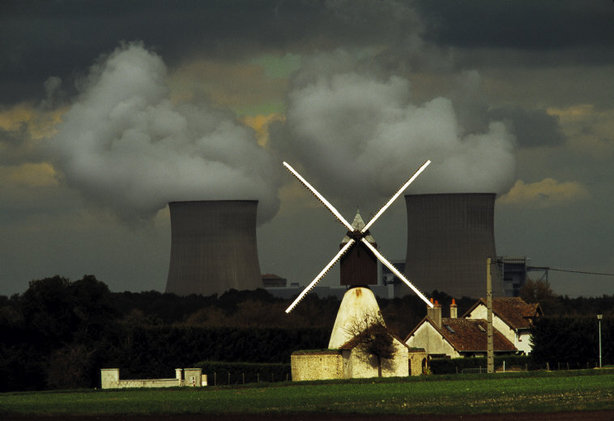
"Two ways to produce electric power without greenhouse gasses."
(caption provided by Barton Nuclear Consulting Services)

(caption provided by Barton Nuclear Consulting Services)
Tuesday, August 31, 2010
Hitch on Beck
As usual, Christopher Hitchens is smart, funny and incisive. Regarding the Glenn Beck affront to intelligence and human decency, he writes:
And of course you get a Hitchens insult, which for my money are the best insults being peddled today:
I'll recommend that you go read the article, it's more than worth it.

And these [various] insinuations [of Obama as Muslim or illegitimate] are perfectly emblematic of the two main fears of the old majority: that it will be submerged by an influx from beyond the borders and that it will be challenged in its traditional ways and faiths by an alien and largely Third World religion.Which is exactly why I have been unwilling to call it plain racism. It's more about losing power than fearing foreigners for the leaders like Beck.
And of course you get a Hitchens insult, which for my money are the best insults being peddled today:
The numbers were impressive enough on their own, but the overall effect was large, vague, moist, and undirected: the Waterworld of white self-pity.I just don't think anyone's doing it as well right now.
I'll recommend that you go read the article, it's more than worth it.
Tuesday, June 22, 2010
When Worlds Collide
Two South Asian co-workers just passed my desk, chatting breezily. One of them was riffing from the old "Let's Call the Whole Thing Off" lyric: "What does it matter? 'tomato', 'tomato'..."
Which is perfectly common except that neither of his two pronunciations of "tomato" were particularly close to two canonical pronunciations from the song.
They were different from each other, so the point would be clear to anyone listening I guess, but it kind of bent my brain a little bit.

Which is perfectly common except that neither of his two pronunciations of "tomato" were particularly close to two canonical pronunciations from the song.
They were different from each other, so the point would be clear to anyone listening I guess, but it kind of bent my brain a little bit.
Saturday, June 05, 2010
Strangeness in NYC
So how did it become okay to make fun of a blind person *for being blind* in the one and only case of the Governor of New York? I mean in no other venue and for no other person do we, the politically correct haven of understanding and intolerance of abusive humor, accept debasing humor of a person's disability. But for Paterson it's perfectly fine to make blind-guy-bumping-into-stuff jokes.
Seems so strange.

Seems so strange.
Thursday, May 27, 2010
Answering a puzzle
Recently in a mailing list I belong to, a friend proposed the following puzzle, which I will reproduce in its entirety (minus the friend's identifying details). I answered him at enough length that I wanted to preserve the discussion.
I will start with the disclaimer that I am not a biologist, let alone an evolutionary biologist, let more alone an evolutionary biologist specializing on origin-of-life studies, so this is all from recent research (and I'll get into the philosophy of science a bit as well).
You asked a cascade of interesting questions about the origin of life. It in indeed a puzzle and one of the most complicated and interesting puzzles we have about the natural world. Life is complicated, and at first blush it's obvious that some things are alive and some things are not. I will continue to harp on this fact: in biology, the boundaries are fuzzy--almost all of them. Sofia Vergara is alive (gloriously alive), and a rock is not alive. That's clear. But just because we can usefully and correctly categorize these two things into these two categories doesn't mean there isn't a fuzzy boundary. When you look very closely at that boundary, as you do with premise #1, you have to start qualifying things. Sofia Vergara and rocks are both collections of atoms that form a sort-of unit with a boundary (again, a fuzzy boundary, but a boundary). As such they are on a continuum. You say it well:
So that's perfectly fair. RNA snippets are often excluded when talking about what is alive and what is not alive. Yeasts are often excluded from the life discussion as well.
But that doesn't mean that in reality they are not on the continuum. By most definitions an RNA snippet is not alive, and that makes some conversation and study into life much easier, because you can talk about "all life is made up of cells". But saying that an RNA snippet is not life is just that, a statement that makes the study of most of life much easier. But reality stubbornly continues to be reality. We call things "alive" or "not alive" but those definitions are our invention. At the boundaries it is nearly impossible to distinguish between the simplest alive thing and the most complicated not-alive thing.
We often talk about species the same way. Sofia Vergara (look her up, she is really super-alive--in this case research can be fun!) is a human (Homo Sapiens). A broccoli plant (less fun to research than Jessica Alba, but sacrifices must be made) is a different species (Brassica Oleracea). That they are different species is true, in the sense that we invented the term "species" exactly so we could have conversations about divisions of life. Again, at the borders it is fuzzy. Cauliflower, for instance, is also Brassica Oleracea. Cauliflower is mostly a different species than broccoli, or at least it is kind of a different species, or it's useful in some contexts to call them different species, and in some others it's more useful to call them the same species. At the boundaries it's fuzzy.
This is true not just of plants, but also of complicated higher animals. I haven't looked it up recently but I think it's true that there are enough dolphin species on Earth that there are lots of what we call dolphin species that have really fuzzy boundaries.
So I'm all behind disqualifying RNA snippets as life for the purposes of this discussion, but it's a false dichotomy to say that there is "life" and "not life" as perfectly disjoint sets.
No question. "Incredible" hardly does it justice.
I agree in the sense that Shakespeare's written plays also "do nothing" on their own. If all humans died tomorrow and the Earth and all its artifacts remained undiscovered by any alien intelligence until the heat death of the universe, a book of those plays would be indistinguishable from any other collection of matter. This whole premise #3 presupposes that "function" has some objective meaning. This is not sophistry, I mean it as a serious part of this discussion. What is a rock "for"? Out in space by itself or rolling down a mountain side--which condition fulfills the rock's purpose? Shakespeare's plays have meaning because we all (as intelligent agents) agree on some common definition of their purpose.
I think you mean that DNA cannot go about the business of being life on its own. Again, for the purposes of this discussion I agree that it makes sense to say that DNA does nothing.
I think I object the word "special" to describe the form of DNA, but it is certainly a particular shape and structure. I only make this point because I think "special" kind of pre-answers the whole puzzle... it reveals what your answer to the puzzle is. Unsurprising to you, I'm sure, is that I think I'm going to answer this puzzle differently than you will, ultimately.
Like the Shakespeare's Plays example I used above "use the DNA for something" presupposes that it has an objective use. The plays (in a book form) could be used to fly through space and re-enter an alien planet to be observed by some aliens looking for shooting stars. Does that book of plays have a purpose beyond its physical interaction with other matter in the universe? Only because a collection of humans agree that it does. I agree, however, that DNA's business of acting as a blueprint for copying units of life cannot be carried on without a bunch of other pieces in place.
True, this process, in order to continue and do the thing that we think of as its purpose, needs to be proximate and protected.
I disagree with this as a premise, and I think most biologists would, too. Here's an example:
We can create machines that make copies of themselves, much like life at the cellular level recapitulates itself. But in order to kick the whole thing off, there is not infinite regress, something else assembles the first machine. I suspect that this statement argues for some other point you imply, but it ultimately argues for both of us.
I don't know.
I'll want to say that the cell wall, while interesting and amazing, does not belong in this discussion. It's very valuable, but it's not impossible for life to proceed without it... higher-lever, organized living creatures need them (Sofia Vergara, for instance, would be far less compelling without the her cell walls), but there's no reason to think that life in its basic form can't get along without cell walls, it needs protection and some proximity, but not necessarily cell walls.
As to the rest of the mechanisms, there are theories. None of them are definitive... like a lot of the very basic science, we will probably never know the answer to a perfect level of confidence. One thing that science is is provisional. Every understanding we have about the natural world (that science has about the natural world) is provisional to some other contradictory evidence disproving our theories.
That having been said, some things are more well known than others, and certain facts about the universe are simply more amenable to answering than others.
Some point of discussion:
The laws of planetary motion are really well understood. They were not initially. There was also a time when the question about how the planets moved may have seemed unanswerable, we lacked the knowledge of what they were, how the solar system was physically arranged, how gravity worked and we even lacked the mathematics to describe it. Slowly and with effort and a lot of years (centuries, in fact) we slowly brought our understanding into focus and it turns out that planetary motion is pretty amenable to understanding. We do not believe that we completely understand planetary motion, it is not 100% sure, but it is, say, 99.999% sure that we do.
How life began is exactly as factual as how planets move. In other words there is an answer to the question. On a theoretical basis it is 100% knowable. It is a harder problem than planetary motion to get at the facts that could answer the question. As a practical matter our assurance that we know the answer of how life began will always have a lower percentage of assurance than for planetary motion.
In a general sense, science is all about developing better and better theories about the natural world. These are often called "models". Our model of planetary motion is really good (we don't know of anything right now that proves our model is not 100%, but science is always provisional). Our model of the large structure of the universe is less good. It's still pretty good, really good in fact, but there are outstanding facts we know about the universe that don't fit the model (dark energy and dark matter are two issues that prove our model is not 100% accurate).
So where do current theories of origin-of-life sit in terms of this "model assurance" discussion? Well pretty far below the others I've discussed.
But that doesn't mean the answers are unknowable. Just that they unknown today. Anything unknown today might remain unknown forever. The origin of things before our direct observation are always more hampered at getting to that 100% model assurance than things we can test more readily.
I suspect that your question is meant to lead the reader toward the conclusion that because we can't answer the final question that the theory of evolution is therefore untenable. I'll address that point directly:
First, we actually agreed more than we disagreed on your premises.
Second, how life began is a fundamentally different question than whether or not evolution is happening, and whether or not evolution drives speciation. (the diversity of species of life)
Third, not knowing how something is happening, or how it began, is not the same as knowing that it happens. Evolution is happening, more and more we understand the mechanism for it, but it is happening.
Fourth, the fuzziness of the boundaries of definition is the key to understanding that evolution drives speciation. Broccoli and Cauliflower are different species... kind of and almost and almost-not and all of that. They are certainly on a continuum that includes broccoli, cauliflower, mustard plants, oak trees, and even animals and humans. Because it's hard to find the boundaries at the most granular level doesn't mean it's not meaningful to talk about the difference between species; conversely, talking about the (working) definitions of species doesn't imply that these things don't lie on a continuum.
Cheers!
[As a point of reference, my discussion of the false dichotomy and continuum of speciation owes a great deal to Dr. Stephen Novella who, to my knowledge, first phrased in the way I've presented it.]

Here's a puzzle I have yet to get valid answer for.
The suppositions first...
1) All life requires DNA. (RNA viral snippets we will not considered to be alive as they have to corrupt a functioning cell to reproduce themselves. For this puzzle they are moot)
2) DNA is an incredible information strand that outlines how proteins are to be built.
3) DNA can do nothing on its own, as its just information encoded.
4) DNA requires a relatively complex decoding sequence to unravel it (it's in a special compressed double helix form), read it, and then build the proteins it describes. I.E. quite a number of intricate molecular machines need to be running to access the DNA and do this work to use the DNA for something.
5) This unraveling, reading and building needs to take place where its not interrupted or spread out. I.e. in a shell of some sort like a cell wall.
6) The original life form which all life is hypothesized to evolved from, had to have DNA, the complex decoder and a shell to keep it all together. Or the unraveled, decoder, and builder parts etc would all drift apart.
Now the puzzle.
If things evolved as hypothesized, where did the first DNA come from? More importantly where did the cell wall, the first decoder that reads DNA and the molecular machinery to act on what is says come from also?
I will start with the disclaimer that I am not a biologist, let alone an evolutionary biologist, let more alone an evolutionary biologist specializing on origin-of-life studies, so this is all from recent research (and I'll get into the philosophy of science a bit as well).
You asked a cascade of interesting questions about the origin of life. It in indeed a puzzle and one of the most complicated and interesting puzzles we have about the natural world. Life is complicated, and at first blush it's obvious that some things are alive and some things are not. I will continue to harp on this fact: in biology, the boundaries are fuzzy--almost all of them. Sofia Vergara is alive (gloriously alive), and a rock is not alive. That's clear. But just because we can usefully and correctly categorize these two things into these two categories doesn't mean there isn't a fuzzy boundary. When you look very closely at that boundary, as you do with premise #1, you have to start qualifying things. Sofia Vergara and rocks are both collections of atoms that form a sort-of unit with a boundary (again, a fuzzy boundary, but a boundary). As such they are on a continuum. You say it well:
1) All life requires DNA. (RNA viral snippets we will not considered to be alive as they have to corrupt a functioning cell to reproduce themselves. For this puzzle they are moot)
So that's perfectly fair. RNA snippets are often excluded when talking about what is alive and what is not alive. Yeasts are often excluded from the life discussion as well.
But that doesn't mean that in reality they are not on the continuum. By most definitions an RNA snippet is not alive, and that makes some conversation and study into life much easier, because you can talk about "all life is made up of cells". But saying that an RNA snippet is not life is just that, a statement that makes the study of most of life much easier. But reality stubbornly continues to be reality. We call things "alive" or "not alive" but those definitions are our invention. At the boundaries it is nearly impossible to distinguish between the simplest alive thing and the most complicated not-alive thing.
We often talk about species the same way. Sofia Vergara (look her up, she is really super-alive--in this case research can be fun!) is a human (Homo Sapiens). A broccoli plant (less fun to research than Jessica Alba, but sacrifices must be made) is a different species (Brassica Oleracea). That they are different species is true, in the sense that we invented the term "species" exactly so we could have conversations about divisions of life. Again, at the borders it is fuzzy. Cauliflower, for instance, is also Brassica Oleracea. Cauliflower is mostly a different species than broccoli, or at least it is kind of a different species, or it's useful in some contexts to call them different species, and in some others it's more useful to call them the same species. At the boundaries it's fuzzy.
This is true not just of plants, but also of complicated higher animals. I haven't looked it up recently but I think it's true that there are enough dolphin species on Earth that there are lots of what we call dolphin species that have really fuzzy boundaries.
So I'm all behind disqualifying RNA snippets as life for the purposes of this discussion, but it's a false dichotomy to say that there is "life" and "not life" as perfectly disjoint sets.
2) DNA is an incredible information strand that outlines how proteins are to be built.
No question. "Incredible" hardly does it justice.
3) DNA can do nothing on its own, as its just information encoded.
I agree in the sense that Shakespeare's written plays also "do nothing" on their own. If all humans died tomorrow and the Earth and all its artifacts remained undiscovered by any alien intelligence until the heat death of the universe, a book of those plays would be indistinguishable from any other collection of matter. This whole premise #3 presupposes that "function" has some objective meaning. This is not sophistry, I mean it as a serious part of this discussion. What is a rock "for"? Out in space by itself or rolling down a mountain side--which condition fulfills the rock's purpose? Shakespeare's plays have meaning because we all (as intelligent agents) agree on some common definition of their purpose.
I think you mean that DNA cannot go about the business of being life on its own. Again, for the purposes of this discussion I agree that it makes sense to say that DNA does nothing.
4) DNA requires a relatively complex decoding sequence to unravel it (it's in a special compressed double helix form), read it, and then build the proteins it describes. I.E. quite a number of intricate molecular machines need to be running to access the DNA and do this work to use the DNA for something.
I think I object the word "special" to describe the form of DNA, but it is certainly a particular shape and structure. I only make this point because I think "special" kind of pre-answers the whole puzzle... it reveals what your answer to the puzzle is. Unsurprising to you, I'm sure, is that I think I'm going to answer this puzzle differently than you will, ultimately.
Like the Shakespeare's Plays example I used above "use the DNA for something" presupposes that it has an objective use. The plays (in a book form) could be used to fly through space and re-enter an alien planet to be observed by some aliens looking for shooting stars. Does that book of plays have a purpose beyond its physical interaction with other matter in the universe? Only because a collection of humans agree that it does. I agree, however, that DNA's business of acting as a blueprint for copying units of life cannot be carried on without a bunch of other pieces in place.
5) This unraveling, reading and building needs to take place where its not interrupted or spread out. I.e. in a shell of some sort like a cell wall.
True, this process, in order to continue and do the thing that we think of as its purpose, needs to be proximate and protected.
6) The original life form which all life is hypothesized to evolved from, had to have DNA, the complex decoder and a shell to keep it all together. Or the unraveled, decoder, and builder parts etc would all drift apart.
I disagree with this as a premise, and I think most biologists would, too. Here's an example:
We can create machines that make copies of themselves, much like life at the cellular level recapitulates itself. But in order to kick the whole thing off, there is not infinite regress, something else assembles the first machine. I suspect that this statement argues for some other point you imply, but it ultimately argues for both of us.
Now the puzzle.
If things evolved as hypothesized, where did the first DNA come from?
I don't know.
More importantly where did the cell wall, the first decoder that reads DNA and the molecular machinery to act on what is says come from also?
I'll want to say that the cell wall, while interesting and amazing, does not belong in this discussion. It's very valuable, but it's not impossible for life to proceed without it... higher-lever, organized living creatures need them (Sofia Vergara, for instance, would be far less compelling without the her cell walls), but there's no reason to think that life in its basic form can't get along without cell walls, it needs protection and some proximity, but not necessarily cell walls.
As to the rest of the mechanisms, there are theories. None of them are definitive... like a lot of the very basic science, we will probably never know the answer to a perfect level of confidence. One thing that science is is provisional. Every understanding we have about the natural world (that science has about the natural world) is provisional to some other contradictory evidence disproving our theories.
That having been said, some things are more well known than others, and certain facts about the universe are simply more amenable to answering than others.
Some point of discussion:
The laws of planetary motion are really well understood. They were not initially. There was also a time when the question about how the planets moved may have seemed unanswerable, we lacked the knowledge of what they were, how the solar system was physically arranged, how gravity worked and we even lacked the mathematics to describe it. Slowly and with effort and a lot of years (centuries, in fact) we slowly brought our understanding into focus and it turns out that planetary motion is pretty amenable to understanding. We do not believe that we completely understand planetary motion, it is not 100% sure, but it is, say, 99.999% sure that we do.
How life began is exactly as factual as how planets move. In other words there is an answer to the question. On a theoretical basis it is 100% knowable. It is a harder problem than planetary motion to get at the facts that could answer the question. As a practical matter our assurance that we know the answer of how life began will always have a lower percentage of assurance than for planetary motion.
In a general sense, science is all about developing better and better theories about the natural world. These are often called "models". Our model of planetary motion is really good (we don't know of anything right now that proves our model is not 100%, but science is always provisional). Our model of the large structure of the universe is less good. It's still pretty good, really good in fact, but there are outstanding facts we know about the universe that don't fit the model (dark energy and dark matter are two issues that prove our model is not 100% accurate).
So where do current theories of origin-of-life sit in terms of this "model assurance" discussion? Well pretty far below the others I've discussed.
But that doesn't mean the answers are unknowable. Just that they unknown today. Anything unknown today might remain unknown forever. The origin of things before our direct observation are always more hampered at getting to that 100% model assurance than things we can test more readily.
I suspect that your question is meant to lead the reader toward the conclusion that because we can't answer the final question that the theory of evolution is therefore untenable. I'll address that point directly:
First, we actually agreed more than we disagreed on your premises.
Second, how life began is a fundamentally different question than whether or not evolution is happening, and whether or not evolution drives speciation. (the diversity of species of life)
Third, not knowing how something is happening, or how it began, is not the same as knowing that it happens. Evolution is happening, more and more we understand the mechanism for it, but it is happening.
Fourth, the fuzziness of the boundaries of definition is the key to understanding that evolution drives speciation. Broccoli and Cauliflower are different species... kind of and almost and almost-not and all of that. They are certainly on a continuum that includes broccoli, cauliflower, mustard plants, oak trees, and even animals and humans. Because it's hard to find the boundaries at the most granular level doesn't mean it's not meaningful to talk about the difference between species; conversely, talking about the (working) definitions of species doesn't imply that these things don't lie on a continuum.
Cheers!
[As a point of reference, my discussion of the false dichotomy and continuum of speciation owes a great deal to Dr. Stephen Novella who, to my knowledge, first phrased in the way I've presented it.]
Thursday, May 06, 2010
Why not a National Day of Oppression?
This is one of those things that I really, really don't get. Some things I hate and disagree with but I understand. For instance, I think bailing out the banks was a really, really bad idea. I think it only adds to the problem that we are divorcing increasingly large proportions of our economy from any moral hazard. It can't end well. But I do understand why people would think otherwise and why they would advocate for action.
But CNN reports that a U.S. Judge has finally noticed that a National Day of Prayer violates the Constitution. I do not get how such a law can pass even the most casual test of Constitutionality. CNN reports:
So our president, the person we elect who is most responsible for protecting and defending the Constitution of the United States will appeal and fight to keep a law which says:
I know the argument is that designating a day to be a day on which the people of the United States may turn to God is not establishing a religion. But being able to articulate an argument doesn't mean the argument is defensible on any level.
The really baffling thing in all of this is that the text of the law makes it clear that the authors know it's a violation. The law says that people "may" turn to God. If you have a law that says what a person "may" do with regard to religion, when your constitution prohibits the Congress from prohbiting the free exercise of religion, well then you don't need that law.

But CNN reports that a U.S. Judge has finally noticed that a National Day of Prayer violates the Constitution. I do not get how such a law can pass even the most casual test of Constitutionality. CNN reports:
The injunction against the National Day of Prayer will not take effect until the defendants in the case, President Obama and White House press secretary Robert Gibbs, exhaust their appeals, according to the decision.
So our president, the person we elect who is most responsible for protecting and defending the Constitution of the United States will appeal and fight to keep a law which says:
And this does not cause him pause when the Constitution he is sworn to protect says:The President shall issue each year a proclamation designating the first Thursday in May as a National Day
of Prayer on which the people of the United States may turn to God in prayer and meditation at churches, in
groups, and as individuals.
Congress shall make no law respecting an establishment of religion, or prohibiting the free exercise thereof...
I know the argument is that designating a day to be a day on which the people of the United States may turn to God is not establishing a religion. But being able to articulate an argument doesn't mean the argument is defensible on any level.
The really baffling thing in all of this is that the text of the law makes it clear that the authors know it's a violation. The law says that people "may" turn to God. If you have a law that says what a person "may" do with regard to religion, when your constitution prohibits the Congress from prohbiting the free exercise of religion, well then you don't need that law.
Subscribe to:
Posts (Atom)